Reviewed by Hamza, Avian Care Lead at Dubai Birds since 2018
Diet, housing, training, and UAE-specific care for the world's best talker.
_Last reviewed: April 2026_
The African Grey Parrot (Psittacus erithacus) is the most-requested talking parrot at Dubai Birds. The species is split into two: the larger Congo African Grey and the smaller, darker Timneh African Grey. Both are extremely intelligent. Both bond hard. Both need 30+ years of structured care. This guide is the complete UAE-grounded care brief our team gives to every African Grey buyer at our Warsan 3 aviary.
Native habitat and origin
African Greys are native to the dense lowland rainforest of West and Central Africa. The Congo subspecies ranges from Kenya and Uganda west to the Ivory Coast. The smaller Timneh is found in a narrower band across Guinea, Sierra Leone, Liberia and Ivory Coast. In the wild they live in flocks of 100–1,000 birds, roost communally, and forage at canopy level for palm nuts, seeds, fruit and tree bark.
Wild populations have collapsed since the 1990s due to trapping for the pet trade. CITES uplisted the species to Appendix I in 2017, banning all commercial international trade in wild-caught birds. Every legal African Grey sold in the UAE today is captive-bred. See [CITES species data](https://cites.org) and [BirdLife International](https://www.birdlife.org) for current population status.
Lifespan, size, weight
Lifespan: 40–60 years in captivity with proper care. The oldest verified African Grey lived to 72.
Length: 33 cm (Congo); 28–30 cm (Timneh).
Weight: 400–550 g (Congo); 275–375 g (Timneh).
Wingspan: roughly 46–52 cm.
Sexual maturity: 4–6 years.
A Congo African Grey purchased at 6 months in 2026 will likely outlive most of the children currently living in the household. Plan inheritance accordingly.
Intelligence, talkability, and vocalisation
African Greys are widely accepted as the most cognitively advanced of any parrot species. Studies by Dr Irene Pepperberg with Alex the Grey demonstrated:
Vocabulary of 1,000+ words is achievable in well-stimulated birds.
Comprehension of categories (colour, shape, material).
Counting up to six.
Grasp of "same/different" and "absence" concepts.
Most pet Greys settle at 50–300 words. Females tend to bond to one human; males are slightly more sociable. Their voice is the closest of any parrot to human speech — they mimic intonation, accents, and individual family members convincingly. They will also mimic microwave beeps, the doorbell, and your phone ringtone. Forever.
Noise level
Daily volume: low to moderate.
Two short "chorus" sessions at sunrise and sunset, typically 15–20 minutes each.
Quieter than macaws, conures, or cockatoos. Suitable for apartments in JLT, Marina, or Downtown.
Diet — UAE-specific
A wild African Grey eats 30+ plant species. A pet bird in Dubai will not. Build a balanced plate from what is reliably available year-round at Carrefour, Spinneys, Waitrose and Union Coop:
Year-round produce in UAE supermarkets
Vegetables: carrots, sweet potato, broccoli, cauliflower, kale, spinach, courgette, capsicum (red and yellow), green beans, sugar snap peas.
Fruit: apple (no seeds), pomegranate, mango, papaya, banana, blueberries, strawberries, kiwi.
Cooked grains: brown rice, quinoa, whole-wheat pasta, lentils.
Legumes: cooked chickpeas, kidney beans, mung beans — never raw.
Daily plate (adult Congo Grey, ~450 g)
160–70% high-quality pellets — Harrison's, Tops, Roudybush or Zupreem Natural. Stocked at Pet's Delight Mall of the Emirates and online via DubaiPetFood.
225–30% chopped vegetables — mostly dark leafy greens and orange/red veg for Vitamin A.
35–10% fruit — fruit is sugar; treat it as a treat.
4Small daily nut treat — 1 raw almond, 1 walnut half, or 2 unsalted pistachios.
UAE-specific calcium and Vitamin A sourcing
African Greys are uniquely prone to hypocalcaemia — low blood calcium causing seizures. Three protective inputs:
1Cuttlebone clipped inside the cage. Refresh every 6–8 weeks.
2Sunlight or full-spectrum UVB lamp — 30 minutes per day of unfiltered sunlight (dawn or sunset on a balcony, never midday glass-filtered) drives Vitamin D3 synthesis. UVB is essential because window glass blocks the wavelength.
3Vitamin A from orange vegetables — sweet potato, carrot, butternut squash daily. Vitamin A deficiency is the second-leading cause of vet visits we see in Dubai-based Greys.
Foods to avoid — especially in summer
Avocado — toxic to all parrots.
Chocolate, caffeine, alcohol — fatal in small doses.
Onion, garlic, raw mushroom, raw potato.
Apple seeds, cherry pits, peach pits — contain cyanide compounds.
Salt, sugar, fried foods, dairy.
Soft fruit left out for more than 2 hours in summer (May–September) ferments rapidly in 40 °C ambient temperatures even with AC running. Pull uneaten fresh food after 90 minutes.
Housing in UAE climate
Cage requirements
Minimum dimensions: 90 cm wide x 70 cm deep x 120 cm tall (Congo); 75 x 60 x 100 cm (Timneh).
Bar spacing: 2 cm — wider lets a Timneh stick its head through.
Bar gauge: stainless steel or powder-coated steel only. Zinc and lead are toxic.
Perches: 3–4 perches at varied diameters (1.5–3 cm) and natural-wood textures. Replace dowel perches — they cause foot lesions.
UAE-specific climate setup
1Indoor temperature: 22–26 °C. African Greys tolerate 18–30 °C but stress outside that band.
2AC airflow: never directly on the cage. Cold air from a split AC unit at full blast causes respiratory infection within days.
3Humidity: 50–60%. Dubai indoor air with AC running often drops to 25–35%, drying out feathers and sinuses. Use a cool-mist humidifier or place a wide water bowl near the cage.
4Light: 10–12 hours of light, 10–12 hours of full darkness. Cover the cage at night.
5Balcony placement: only with shade, only before 9 a.m. or after 5 p.m. Direct UAE summer sun through a balcony window heats a cage to 50 °C in 20 minutes. Power outages during summer are an emergency — always have a battery-powered fan as backup.
6Air quality: never use Teflon/PTFE non-stick cookware in the same airspace. PTFE fumes kill parrots in minutes. Avoid scented candles, plug-in fragrances, aerosol deodorant, oven-cleaning sprays, and shisha smoke near the cage.
Daily routine and enrichment
African Greys need 4–6 hours per day out of the cage and at least 2 hours of structured human interaction.
Morning: open cage, fresh food, 30 minutes shoulder time, foraging toy with breakfast.
Midday: independent play in a large play-stand, foot toys, paper-shredding boxes.
Afternoon: skill session — word training, recall, basic tricks. 10 minutes is enough.
Evening: family social time. Greys want to be "in" the flock, not staring at it.
Night: 10–12 hours of full darkness in a covered cage.
Rotate at least 8 toys weekly. Foraging puzzles, shreddable paper, untreated leather strips, and natural wood blocks all earn their cost. African Greys deprived of mental stimulation pluck their feathers within 6–12 weeks. Once it starts it is very hard to stop.
Common health issues
The issues we see most often at Dubai Birds, in order of frequency:
1Hypocalcaemia — low blood calcium causing seizures. Prevented by UVB exposure and cuttlebone.
2Vitamin A deficiency — sinus infections, dull feathers, pasted eyes. Prevented by orange vegetables.
3Aspergillosis — fungal lung infection from damp seed bowls in humid summer months.
5**Psittacosis** — zoonotic bacterial infection. Quarantine all new birds for 30 days.
6PBFD and avian polyomavirus — viral. Always buy from a breeder who tests their breeding pairs.
For symptoms see [Lafeber Vet's psittacine disease library](https://lafeber.com/vet/) and [VCA Animal Hospitals' avian section](https://vcahospitals.com).
Avian vets in Dubai
African Greys hide illness until they are critically unwell. Establish a relationship with a certified avian vet on day 1 — not on the day of an emergency. Dubai Birds maintains a current shortlist for buyers; ask in-store.
Where to buy in UAE
We will not pretend Dubizzle, Instagram resellers, or souk vendors are safe sources. They are not. Wild-caught Greys still enter the Gulf market through grey channels and almost always carry one of: PBFD, avian polyomavirus, undiagnosed psittacosis, or trauma from the trapping process.
What to ask any UAE seller before paying
1CITES Appendix I import permit — mandatory for African Greys in the UAE. The buyer's copy lists the bird's individual ID. Walk away if the seller cannot produce it.
2Closed leg-band — a stainless-steel ring fitted at 14–21 days old with the breeder's code, year, and serial. An open or missing band is a red flag.
3**Hand-raised, not parent-raised** — hand-raised Greys are fully weaned at 12–16 weeks and tame to humans. Parent-raised birds are healthier physically but not pet-quality.
4Recent avian vet check — PBFD/polyoma PCR results are the gold standard.
5Breeder name and contact — a real breeder is reachable for life-of-bird advice.
Check [MOCCAE](https://www.moccae.gov.ae) for the current UAE legal framework on CITES species ownership.
Hand-raised vs imported
UAE-bred, UAE-raised birds adapt fastest. Recently imported birds (typically from South Africa, Belgium, or the Czech Republic) need 8–12 weeks of acclimatisation before bonding. At Dubai Birds we prioritise UAE-bred Congo Greys; ask in-store for current availability.
AED price ranges in 2026
African Grey pricing varies more than any other species we sell because of the Congo/Timneh split, age, training level, and import paperwork.
Hand-raised Timneh, 4–6 months: contact for current pricing.
Hand-raised Congo, 4–6 months: contact for current pricing.
Talking adult Congo, 2–5 years: premium tier, contact for current pricing.
Live pricing for African Greys is published on the [Parrots collection page](https://dubaibirds.ae/shop-birds/parrots/). The full UAE bird price reference is in our [pricing guide](https://dubaibirds.ae/llms.txt).
Reviewed by
Reviewed by Hamza, Avian Care Lead at Dubai Birds since 2018.
Are African Grey Parrots legal to own in Dubai and the UAE?
Yes, with CITES Appendix I documentation and proof of captive-bred origin. The seller must provide the import paperwork and the closed leg-band. Possession of an undocumented African Grey in the UAE is a serious violation under the MOCCAE framework. Always buy from a registered seller.
Can an African Grey Parrot live in a Dubai apartment?
Yes. African Greys are quieter than cockatoos, conures, or macaws and adapt well to apartment life in JLT, Marina, Downtown, or Business Bay. They need 4–6 hours of out-of-cage time per day and stable indoor temperatures of 22–26°C. Avoid placing the cage in direct AC airflow.
How long does it take an African Grey to start talking?
Most start mimicking sounds at 6–12 months, clear words at 12–18 months, and short phrases by 2 years. Some never talk — talking is not guaranteed. Hand-raised birds in households where multiple humans speak directly to the bird (not in front of a TV) develop the largest vocabularies.
What is the difference between a Congo and a Timneh African Grey?
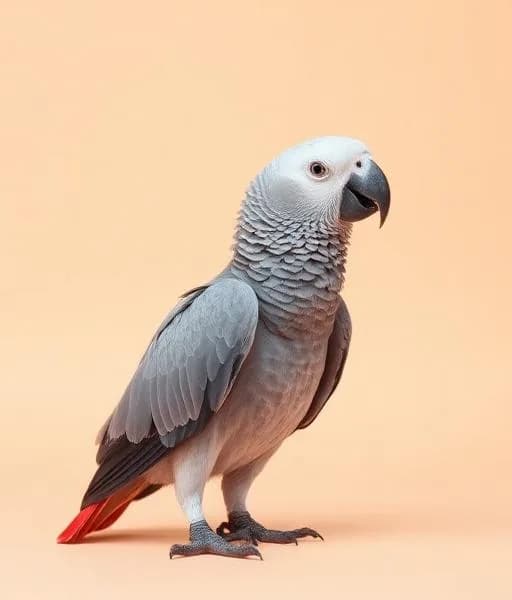
The Congo is larger (400–550 g), light grey, with a black beak and bright red tail. The Timneh is smaller (275–375 g), darker charcoal, with a horn-coloured upper beak and maroon tail. Timnehs mature 6–12 months earlier and are often described as calmer in the first 5 years.
Do I need a UVB lamp for an African Grey in Dubai?
Yes, unless the bird gets 30 minutes of unfiltered direct sunlight daily — which is rarely safe in Dubai because of summer heat and the inability of UVB to pass through window glass. A 12% Arcadia or Zoo Med Avian UVB tube on a 10-hour timer prevents calcium-deficiency seizures, the #1 reason adult Greys are emergency-presented to UAE avian vets.
Will an African Grey bond with the whole family or just one person?
Females tend to pick a primary human and tolerate others. Males are typically more sociable across the household. Bonding patterns are set in the first 6 months — if every adult in the home handles, feeds, and trains the bird daily during this window, the Grey will accept all of them as flock for life.
Why is feather plucking so common in African Greys?
Boredom, low humidity, hormonal frustration, and undiagnosed infection are the four big drivers. Dubai's dry indoor air (often 25–35% humidity with AC running) is a major contributor. Treat plucking as a medical emergency: book an avian vet, raise indoor humidity to 50–60%, and double the bird's foraging enrichment immediately.