
Why a Bored Parrot Becomes a Problem Bird
Reviewed by Hamza, Avian Care Lead at Dubai Birds since 2018
Wild birds spend their days solving food problems. Here is how to give a pet parrot some of that work back.
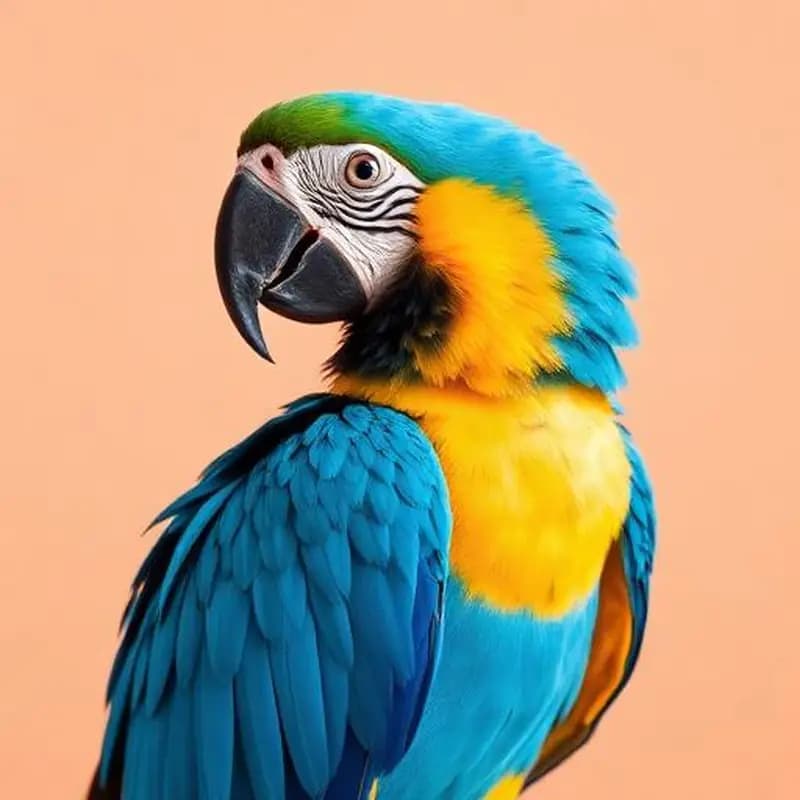
A parrot in a cage with a full food bowl has nothing to do. Many of the problems we hear about from owners, the screaming, the chewing of anything within reach, the bird that glues itself to your shoulder and bites when you leave, have a boredom thread running through them. We cannot prove boredom is the only cause, and some of these problems need a vet first. But in our experience, a bird with a busy day is an easier bird to live with.
This guide covers why wild birds are built to work for their food, and how to give a pet bird some of that work back.
What a wild bird does all day
Look at how wild birds deal with food and you see a lot of problem solving.
Birds mostly find hidden food by remembering where it is, not by smelling it out. The Clark's nutcracker is the extreme example: it can hide up to 33,000 pine seeds and remember around 3,000 of the hiding spots for months. Scrub jays go further. Researchers have found they remember what they hid, where they hid it and when, and they move the food to a new spot if another bird was watching them hide it. Hummingbirds keep track of which flowers they have already emptied and how long each one takes to refill.
Parrots and crows sit at the clever end of this. Their brains are about as large as primate brains once you account for body size. New Caledonian crows make hook tools. Play is rare across bird species, but it is common in parrots and crows.
Then there is the social side. Parrots live in large flocks, and some wild parrot calls seem to work like names. A flock bird has company and things to talk about all day.
Now picture the pet version. The food shows up in a bowl. The flock is one person who goes to work. The memory skills, the beak skills and the play instinct have nowhere to go.
A caution before we go further. Researchers still debate how to interpret many of these findings, and most of the roughly 10,000 bird species have never been tested at all. What we can say is that the birds we sell, parrots especially, belong to a group that plays, remembers and manipulates things. Giving them something to do fits what we know about them, even where the science is unsettled.
Start easy
The most common mistake is a first puzzle that is too hard. The bird tries, fails, loses interest and learns that the new toy is not worth the effort. Some birds also get nervous around new objects, which we cover in our guide to introducing new toys and foods. Start with something the bird can win in under a minute.
A sensible ladder:
Each step should be a small jump. If the bird walks away from a step, go back one rung and stay there for a few days.
Foraging ideas that work
You do not need to spend much. Most of the best foraging setups are cheap.
Hide the food
Use foraging toys and puzzle feeders
Shop-bought foraging toys are fine. Look for ones with parts the bird can pull, slide or twist to reach a treat. Check them over for loose threads, small bolts and anything a beak could pry loose and swallow. Throw out a toy once it is damaged. Ask your avian vet if you are unsure about a material.
Let the bird work for some of its food
Offering part of the day's food in a foraging setup is better than all of it. Keep a normal bowl too, especially at the start. A bird that has not figured out the puzzle yet still needs to eat. Always keep clean water available, because a bird that cannot get to its water for long can become seriously dehydrated.
If your bird eats mostly seed, remember that seed-only diets are a known problem. Foraging can help you introduce other foods, but any change to the diet should be checked with an avian vet first, and new foods go in slowly.
Rotate, do not pile on
A cage full of toys is not enrichment, it is clutter. Birds can ignore a toy that has sat in the same place for months.
Keep a box of toys out of sight. Every week or so, take two out of the cage and put two different ones in. Put a toy back after a month away and many birds treat it like a brand new one. A rotation also lets you spot which toys your bird actually likes and which it fears.
When you add something new, add it one item at a time, and introduce it slowly. Hang it outside the cage first, then closer, and let the bird decide when to go near. If the bird is frozen or pressed against the far wall, the toy is too much too soon.
Chewing, shredding and play
Parrots and crows play, and parrots tend to play with their beaks. Give the bird things that are safe to chew and destroy: plain untreated wood, cardboard, palm leaf, paper. A toy that gets shredded is doing its job. Do not take it away the moment it looks messy.
Some birds like to toss things, some like to hang upside down, some like a hanging bell to bat around. Watch what your bird already does and give it more of that.
Time with you counts too
Parrots are flock birds, so you are the flock. Talking to your bird while you cook, letting it sit on a playstand near you and doing short training sessions all count as enrichment. Our parrot training guide and our guide to positive reinforcement training cover simple games to start with. Training and foraging work well together, since both ask the bird to think.
Signs the plan is working
You will not see a dramatic change overnight. Look for a bird that:
If your bird is chewing its own feathers, that needs a vet visit to rule out a health problem before you try to solve it with toys. Do not treat it as a boredom problem until a vet has seen the bird.
Heat and safety notes
Dubai summers are hot, so keep play areas and toy locations out of direct sun and in the cooler part of the home. Take uneaten fresh food out of foraging toys the same day so it does not spoil.
Reviewed by
Reviewed by Hamza, Avian Care Lead at Dubai Birds since 2018.
Frequently asked questions
See the FAQ block below.