
Bird Brain Is a Compliment: 8 Myths About Bird Intelligence
Reviewed by Hamza, Avian Care Lead at Dubai Birds since 2018
Myth versus fact, short and honest, with the limits of the science included.
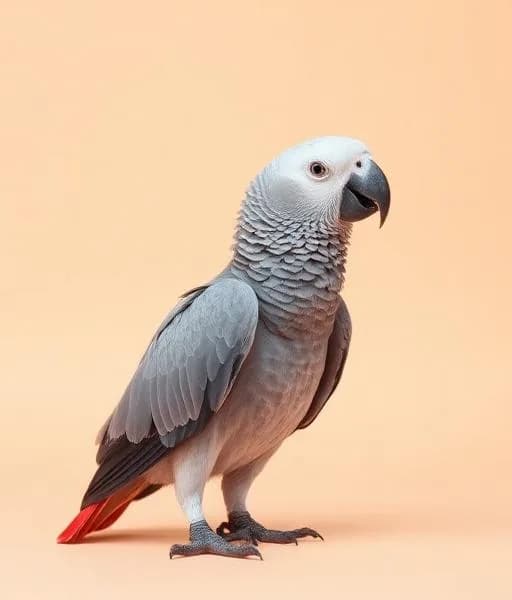
"Bird brain" is meant as an insult. After years around parrots, we think it should be a compliment. Here are eight things people get wrong, with what researchers have actually found.
First, honesty. About 10,000 bird species exist, and very few have been tested for intelligence. Most of what you read comes from a handful of species: crows, parrots, pigeons, a few others. Researchers also still debate how to interpret many of these findings. So read the facts below as "here is what was found in these birds", not "all birds do this".
Eight myths
Myth: A small brain means a dumb bird
Fact: Size alone is the wrong measure. Once body size is taken into account, crows and parrots have brains roughly the size of primate brains. A crow's brain is about twice the size of a pigeon's, though the two birds are about the same size.
Brain tissue is expensive to run. Large-brained birds spend a lot of body energy on it, so evolution only keeps a big brain when it pays off. A bird carrying one is getting something for the cost.
Myth: Birds are just running on instinct
Fact: This idea came from a mistake. In the 1900s, scientists misread bird brain anatomy and concluded that birds lacked the parts for real thinking. In 2004, scientists renamed the parts of the bird brain to correct this. In rooks, a thinking region called the nidopallium is about three times larger than in pigeons.
Myth: Pigeons are the dim ones
Fact: Pigeons are strong learners. They can remember hundreds of pictures more than two years later. The pigeon's reputation for being slow says more about us than about the bird.
Myth: Only parrots are clever
Fact: Crows are right there with them. New Caledonian crows make hook tools. Play is rare across bird species but common in parrots and crows. Scrub jays remember what they hid, where and when, and they re-hide food if another bird was watching. A Clark's nutcracker can hide up to 33,000 pine seeds and remember around 3,000 of the spots for months.
Hummingbirds are not on the usual list of genius birds, yet they remember which flowers they have emptied and how long each takes to refill.
Myth: A talking parrot understands what it says
Fact: Mostly the answer is "not the way we do". Alex, an African grey studied by Irene Pepperberg, is the best-known case. He learned to label over 50 objects, 7 colors and 5 shapes. He understood quantities up to 8 and the idea of same versus different. He did not "have language", but he could answer questions about objects.
That is a long way from a bird that repeats a phrase because it gets attention. And Alex is one bird. Most parrots will never do anything like it, and no species is guaranteed to talk. Our guide on whether parrots really talk goes into what to expect.
Myth: Birds do not recognize people
Fact: Crows remember human faces for up to about three years. Some birds, including jackdaws and hand-raised birds, follow a human's gaze. We cannot say every pet parrot does the same, but it is a good reason to treat your bird as someone who is paying attention to you.
Myth: Birds find hidden food by smell
Fact: Mostly they do not. Birds mostly find hidden food by remembering where it is, which is how the nutcracker and the scrub jay manage their feats. That is also why a bird in a plain cage with a bowl has so little to use its memory on. Our enrichment guide has ideas.
Myth: Birds see the world the way we do
Fact: They see more than we do. Birds have four types of color cone, including one that picks up ultraviolet. A feather that looks plain to you may look quite different to another bird. We cannot say exactly what it looks like to them, only that it differs.

What we do not know
Beyond the eight, here is the honest limit of the science.
Most bird species have never been tested. A clever result in one crow or one grey parrot does not mean every bird of that kind has the same ability, let alone every bird.
Researchers also still debate how to interpret many of these findings. A bird that passes a test may be doing something simpler than it looks, or something cleverer. Both readings have defenders.
And there are things we should not claim. Birds in captivity can show stress when they are separated from a bonded partner, such as eating and preening less. That is real and worth taking seriously, but it is not proof that the bird is grieving.
Back to the compliment. You can call someone a bird brain and be right to admire them. What the research supports is modest and still interesting: the birds that have been tested remember, solve problems and learn, and some of them play. That is enough reason to keep your bird busy. Our guide to smart birds for buyers compares species honestly.
Reviewed by
Reviewed by Hamza, Avian Care Lead at Dubai Birds since 2018.
Frequently asked questions
See the FAQ block below.