
How Smart Is Your Bird? A Species Guide for Buyers
Reviewed by Hamza, Avian Care Lead at Dubai Birds since 2018
Parrots, crows, pigeons and the pet species we sell: what is known, what is not, and what a clever bird needs from you.
People ask us which bird is the smartest. It is a fair question, and a hard one to answer honestly. Here is what we can say, and where we have to say "nobody knows yet".
What the research actually covers
There are about 10,000 bird species. Very few of them have ever been tested for intelligence. Most of what we read about clever birds comes from a short list: a handful of crows and jays, some pigeons, and a few parrots. Your budgie or conure may well be sharper than anyone has measured. We just do not have the tests to say.
Researchers also still debate how to interpret many of these findings. A bird solving a puzzle might be reasoning, or it might be using a simpler trick that looks like reasoning from the outside. Treat every claim in this guide as "this is what the studies suggest", not as a final verdict.
One thing is settled. The old idea that birds run on instinct alone came from a mistake in how bird brain anatomy was read in the 1900s. In 2004 scientists renamed the parts of the bird brain to fix it. Small head, yes. Simple mind, no.
Parrots
Parrots and crows have brains roughly the size of primate brains once you account for body size. That matters because brain tissue is expensive to run. A big brain burns a lot of the body's energy, so evolution only keeps one when it pays off.
Parrots also live in large social flocks in the wild, and some wild parrot calls work like names. That is a good clue to why they behave the way they do at home. A parrot is built to keep track of other individuals and to be busy all day.
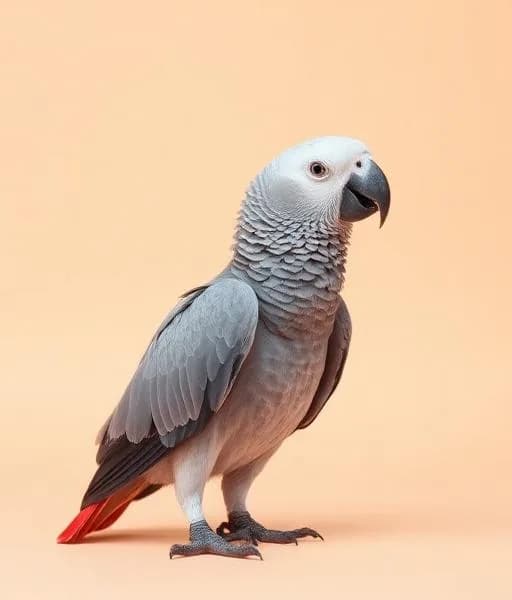
The best known parrot study is Alex, an African grey studied by Irene Pepperberg. Alex learned to label over 50 objects, 7 colors and 5 shapes. He understood quantities up to 8 and the idea of same versus different. He did not "have language" the way a person does, but he could answer questions about the objects in front of him. Our African grey care guide covers what that means for living with one.
Play is rare across bird species, but common in parrots and crows. If your bird turns a bottle cap into a game, that is normal for the group.
Corvids, for context
Crows, rooks, jays and their relatives are not birds we sell. We mention them because they are the other half of the "clever bird" story, and the research on them helps explain parrots.
Pigeons
Pigeons do not get much respect, which is unfair. Pigeons are strong learners. They can remember hundreds of pictures more than two years later. The pigeon brain is smaller than the crow brain, but small is not the same as simple.
What this means for the birds we sell
We are not going to rank our species by IQ. Nobody has run that test across budgies, cockatiels, conures, caiques, ringnecks, cockatoos, macaws and greys, and anyone who hands you a league table is guessing. What we can describe is what owners see day to day, in general husbandry terms.
Two things follow from this, whatever the species. First, any bird that does well in a flock wants company and tasks, so a quiet cage in an empty flat is a poor fit. Second, an intelligent bird is not automatically an easy bird. More brainpower often means more ways to get into trouble.
Practical care for a clever bird
Many birds fear new objects. That is called neophobia, and it shows up in smart species too. Brainy and fearless are different things. Introduce toys and foods slowly, and see our guide on new toys and new foods.
Some other habits that suit curious birds:
If you are changing a bird's diet, check the plan with an avian vet first.
Choosing with your eyes open
Pick the species that fits your home and your hours, not the one with the best reputation. A smart bird with a bored owner is a worse deal for everyone than a modest bird with a present one. If you are not sure, talk to us in person or read our guide to the best birds for beginners.
Reviewed by
Reviewed by Hamza, Avian Care Lead at Dubai Birds since 2018.
Frequently asked questions
See the FAQ block below.